Sedona's history is easier to see when you know where to look. A fruit-packing shed became an arts gathering place. A former orchard is now a museum. On Brewer Road, the 1926 Hart Store still welcomes people through its doors, today as Mi Amoré Sedona. Behind the familiar vacation scenery is a story of Indigenous homelands, farming, film crews and a small community that became a city surprisingly late.
Two dates answer different versions of “How old is Sedona?” The post office opened under the name Sedona on June 26, 1902. The City of Sedona incorporated on January 4, 1988. Neither date is the beginning of people living in this landscape. Understanding that distinction makes the town's history much more interesting than a simple founding story.
If this history has you imagining a longer stay, our guide to everyday life in Sedona shifts from the visitor story to neighborhoods, errands and the practical questions behind a move.
Before Sedona was a town: communities across the Verde Valley
The National Park Service traces human presence in the Verde Valley back around 10,000 years. Later communities grew crops, built villages and traded across the Southwest. The cliff dwellings and rock images near Sedona are part of that regional story, rather than isolated curiosities tucked into the rocks.
You will often encounter the name Sinagua in site interpretation. It is an archaeological label used for past communities, not a reason to treat them as a people who simply vanished. The Park Service's account of Tuzigoot describes Hopi migration traditions, Yavapai ancestors and Zuni accounts of people who remained. The connections between past villages and living communities matter as much as the surviving walls.
Palatki and Honanki, northwest of Sedona, preserve cliff dwellings and rock images. The Forest Service describes them as major settlements in the red-rock region during the twelfth through fourteenth centuries, with rock art showing use by more than one culture over a much longer period. Montezuma Castle near Camp Verde and Tuzigoot near Clarkdale tell other parts of the Verde Valley's history. They are regional outings, not stops on an Uptown shopping walk.
The Yavapai and Apache have their own histories in these homelands. The Yavapai-Apache Nation's account of its ancestral lands describes the U.S. government's forced removal of people from the Verde Valley to San Carlos in 1875, and the later return of families to the valley. A history that moves straight from “ancient people” to picturesque homesteads leaves out a consequential part of what happened here.
Read the cultural context: the National Park Service's human history of Tuzigoot and the Verde Valley.
Oak Creek made orchards possible
The museum's account of nineteenth-century homesteading begins with Jim Thompson in Oak Creek Canyon in 1876. More families followed, developing farms, ranches and irrigation systems. That date describes the Euro-American settlement chapter; it does not make the land previously uninhabited.
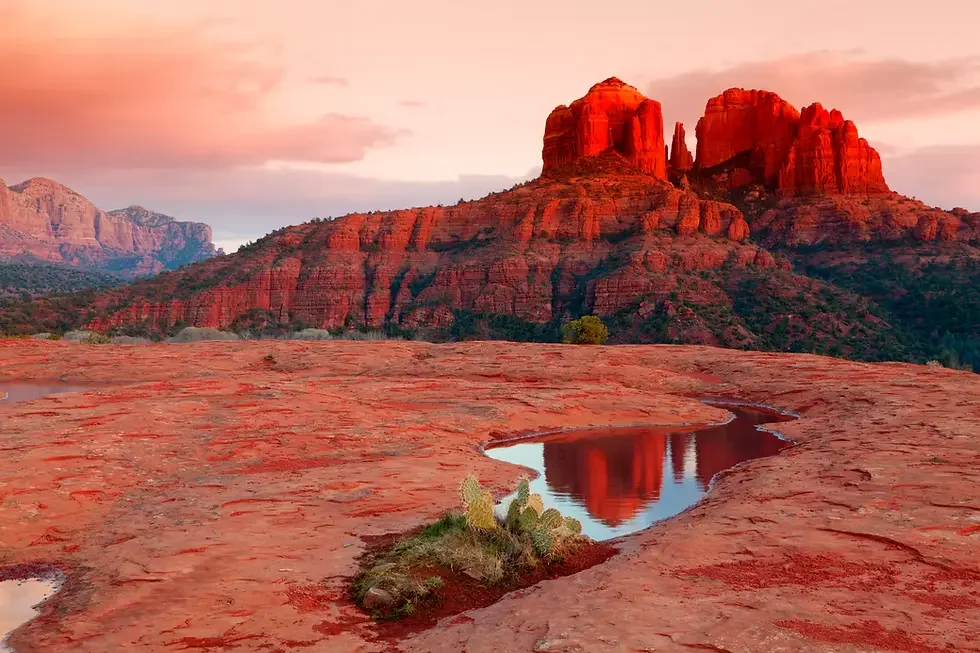
Water explains why the early community took the shape it did. Oak Creek supported gardens and orchards, with apples and peaches becoming important crops. Farmers used ditches, flumes and pipelines to move water, and sent fruit to markets in towns including Jerome and Flagstaff. Sedona's early economy was tied to the creek and the work of getting produce out of the valley, long before visitors came for a red-rock weekend.
The Jordan farmstead is one of the clearest surviving ways to understand that period. Walter and Ruth Jordan's home, tractor shed and fruit-packing shed stand at 735 Jordan Road, now the Sedona Heritage Museum in Jordan Historical Park. The buildings and orchard exhibits make the farming story tangible: the landscape was a workplace as well as a beautiful place to live.
Commercial orcharding largely faded during the 1970s and 1980s, according to the museum. But the agricultural chapter did not disappear without a trace. The Jordan property, preserved for public use and opened as a museum in 1998, lets you look beyond today's storefronts to the economy that preceded them.
How Sedona got its name in 1902
Theodore Carlton “T.C.” Schnebly wanted regular mail service for the small community. His home near the area now occupied by Tlaquepaque and Los Abrigados also served as a general store and hotel. When he applied for a post office, the proposed names Oak Creek Crossing and Schnebly Station were rejected; local historical accounts explain that postal officials preferred a shorter, one-word name.
T.C.'s brother Ellsworth suggested the name of T.C.'s wife, Sedona Miller Schnebly. The post office began operating as Sedona on June 26, 1902. The name came from a real woman, rather than from a Spanish description of the rocks or an Indigenous word for spiritual energy.
The Sedona Heritage Museum explains that Sedona's mother, Amanda Miller, created the name for her daughter because she liked its sound. That small family decision eventually became the name on road signs, maps and travel plans around the world. If the name's meaning brought you to this article, the useful answer is its personal origin, not an invented translation.
Historical sources: Visit Sedona's post-office history and the Sedona Heritage Museum's namesake and orchard account.
The Hart Store and the early commercial center
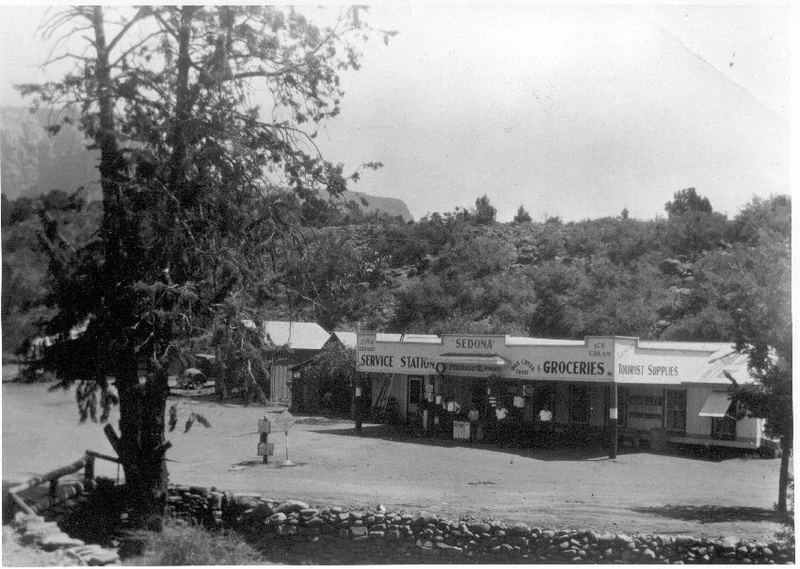
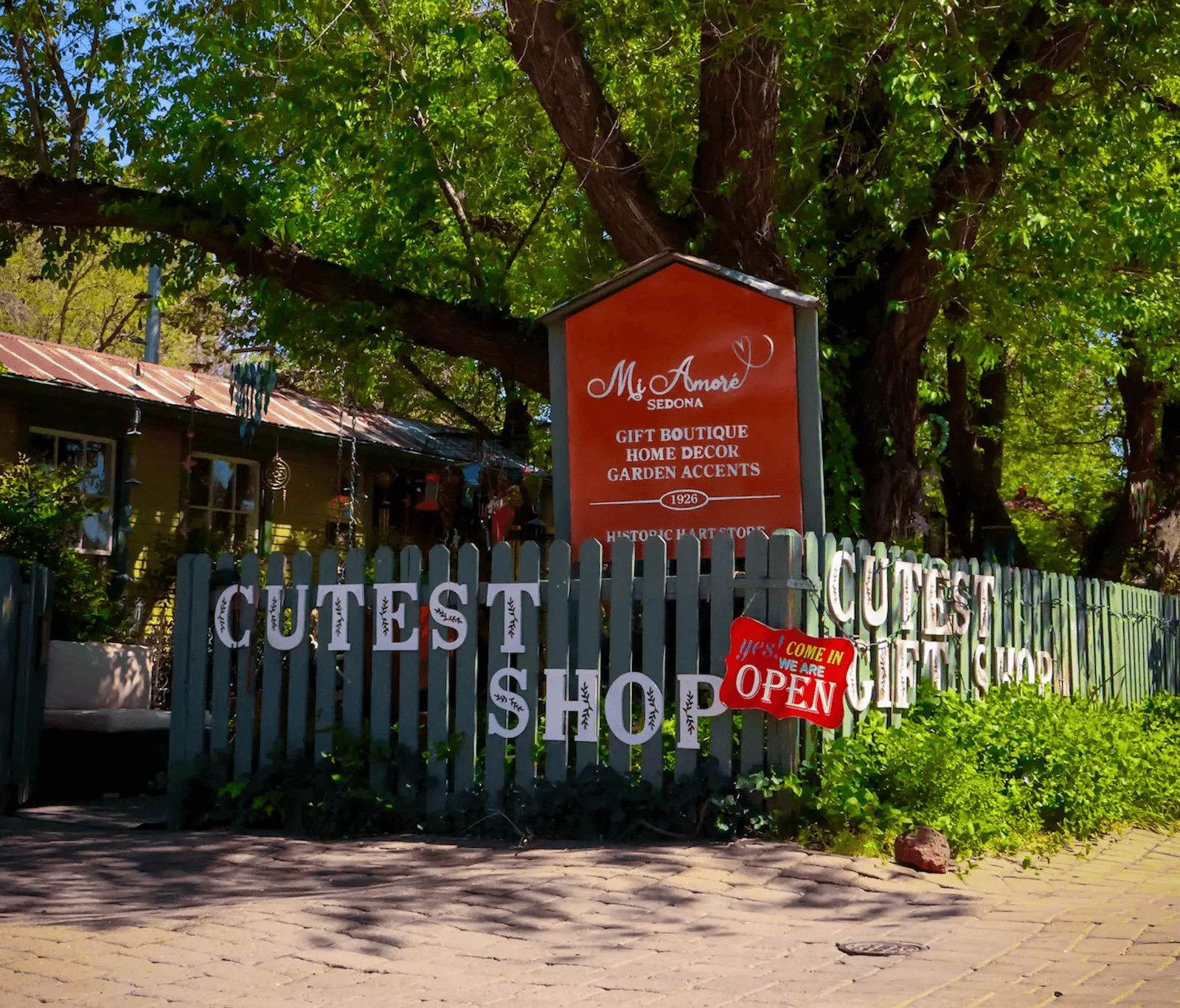
The Hart Store belongs to that practical side of the town's history. Built in 1926 at 100 Brewer Road for L.E. “Dad” Hart, it is listed by the City as a historic landmark and a National Register property. Its location is near Ranger Road and the Tlaquepaque/Brewer Road area, south of Uptown's main shopping stretch.
The City-installed historical marker describes a general store selling Oak Creek fruit and tourist supplies, with gravity-fed gasoline pumps. It also remembers Hart extending credit during the Great Depression and supporting improvements to the roads. Those details give the building more character than simply calling it an old store: it served residents' daily needs while the area was beginning to welcome more travelers.
The same marker records that the business moved when the road was rerouted, and that this building later spent decades as a duplex. Its story was not one uninterrupted century of operating as the same shop. Today's use is another chapter in the life of a preserved building.
It now houses Mi Amoré Sedona, with curated gifts and home-and-garden pieces. Visiting gives you a straightforward way to include the historic commercial district in your day without needing a separate tour reservation. The store is a living business, so enjoy the building and its marker alongside the browsing rather than expecting a museum exhibition inside.
Historic records: the City's designated landmarks and photographed City Hart Store marker.
Hollywood found the red rocks before the postwar tourism boom
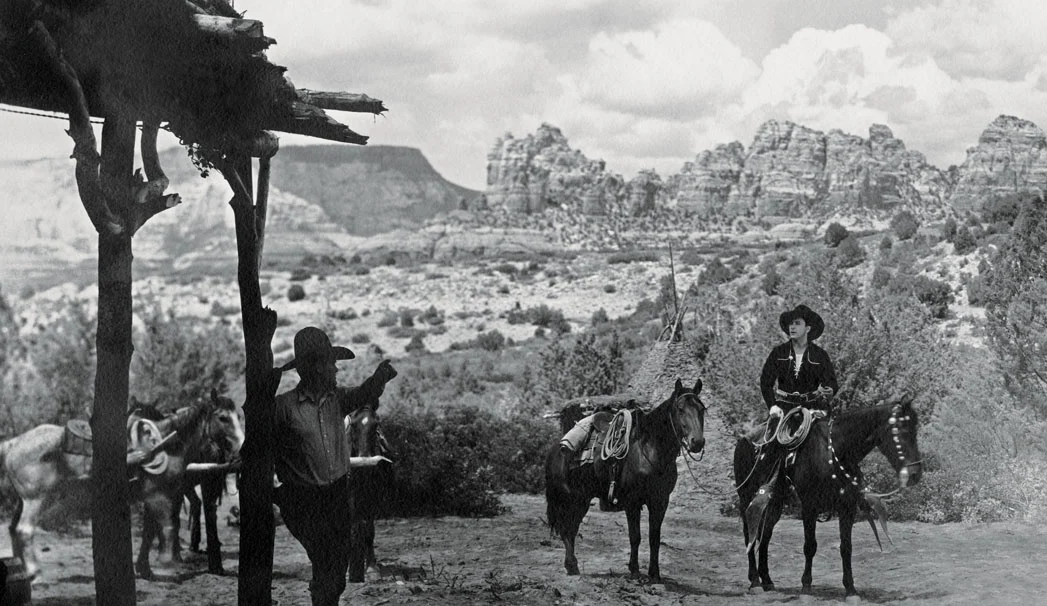
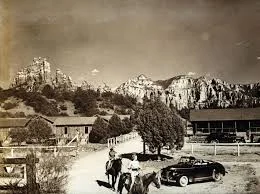
Sedona's movie history began before the 1940s and 1950s Westerns most visitors recognize. The Heritage Museum dates local moviemaking to 1923, with the silent film The Call of the Canyon, based on Zane Grey's novel. The landscape could play the part of the cinematic West long before Sedona had today's visitor infrastructure.
The later Western era brought productions such as Angel and the Badman (1947), Blood on the Moon (1948) and Broken Arrow (1950). The museum describes sets, a soundstage and accommodation built for the John Wayne production. Film work existed alongside the area's orchards and ranching, rather than replacing them overnight.
There is something from that chapter you can still visit: a telegraph-office building from the movie set, associated with Angel and the Badman, was moved to the museum grounds in 2014. It is a more concrete connection than assuming every scenic trail was a specific filming location.
The films helped carry Sedona's appearance far beyond Arizona, but they are only one part of why it became a destination. Improved access, the growing arts community and later visitor businesses also shaped the town. A movie backdrop and the history of the people living behind it are different stories worth keeping together.
Film evidence: Arizona Highways' movie-history account in the Arizona Memory Project and the museum's preserved buildings and movie-set exhibit.
Art and architecture gave Sedona another identity
The Chapel of the Holy Cross was completed in 1956, commissioned by sculptor and rancher Marguerite Brunswig Staude. The Chapel's own history identifies Richard Hein as project architect and August K. Strotz as the designer, from Anshen & Allen. Its modern form set into the rock makes it a striking example of a building created in response to the landscape, not a surviving frontier church.
Sedona's arts institutions also have a specific beginning. In 1958, Nassan Gobran and a group of local supporters established Canyon Kiva. They used the former Jordan Apple Packing Barn as a place for artists to work, teach and gather. It became Sedona Arts Center in 1961, continuing a connection between the old agricultural community and the creative one growing around it.
Then, in the 1970s, Abe Miller developed Tlaquepaque, inspired by the arts village of San Pedro Tlaquepaque near Guadalajara. The preserved sycamores and deliberately composed courtyards contribute to the impression of a much older village. Its atmosphere is part of its design history; it is not a centuries-old Mexican settlement transported intact to Arizona.
You can experience these chapters with very different kinds of visits: a quiet stop inside the Chapel, a gallery browse or class at the Arts Center, and an unhurried wander through Tlaquepaque. The arts story is still being made, rather than ending with the dates on the buildings.
Read the organizations' histories: Chapel of the Holy Cross, Sedona Arts Center and Tlaquepaque.
Why 1988 matters: a community became a city
Sedona had a post office, farms, stores, film sets and galleries long before it had its own city government. It straddled Coconino and Yavapai Counties, with the counties responsible for the area before incorporation. The City Clerk's records identify January 4, 1988 as the incorporation date.
That is why calling 1902 the founding date and 1988 the incorporation date can both be correct, provided the distinction is explained. One marks the named postal community; the other marks municipal government. Neither should erase the much longer Indigenous history.
Today's destination adds hiking, scenic drives, resorts and spiritual retreats to those earlier chapters. Sedona's reputation for vortex sites belongs to beliefs and modern spiritual tourism; it should not be treated as proof of a scientifically established energy phenomenon or used to speak for every Indigenous tradition. For that separate subject, continue with our guide to Sedona's spiritual reputation.
Where to experience the history on your visit
Start with the Sedona Heritage Museum in Uptown
The museum at 735 Jordan Road brings the namesake, orchard, ranching and movie stories together on the former Jordan farmstead. As checked in September 2026, it opens daily, 11am–3pm, with major-holiday closures. Adult admission is $10; children under 13 are free. Check the museum visit page for your date and the separate program calendar if you want an event.
Give the museum an unhurried part of the middle of the day. Its limited opening window means it is not a stop to save until after a long afternoon hike. From there, Uptown and the Arts Center make sense as another part of the day, but the museum is farther up Jordan Road than the main roadside shopping blocks.
Choose a heritage site according to access, not just its photograph
Palatki requires a timed reservation through Recreation.gov, plus a Red Rock Pass or qualifying Interagency Pass for your vehicle. The road has rough gravel sections, and the tour includes uneven, strenuous steps. It is not a casual walk-in alternative to shopping. Follow the live reservation calendar, which supplies the available dates and times.
Honanki is also reached on rough roads northwest of town; the Forest Service recommends high clearance. Both sites can close because of heat or impassable roads. Bring water, stay in permitted areas and leave rock images and masonry untouched. These are protected cultural places, not structures to climb for a photograph. Consult the current Honanki information before going.
For a heritage outing with a paved approach, Montezuma Castle near Camp Verde offers a wheelchair- and stroller-accessible 0.3-mile loop below the dwelling. You view it from the ground; public access inside the cliff dwelling ended in 1951. Montezuma Well is a separate location with different terrain, so the Castle's access description does not apply to both. Read the Park Service's site-specific accessibility information.
Finish with the historic commercial district on Brewer Road
If you are spending the afternoon around Tlaquepaque, include the Hart Store at 100 Brewer Road rather than searching for it on Uptown's Main Street. Mi Amoré Sedona opens daily, 10am–4:30pm. It is an easy reason to slow down, read the marker and choose a gift in a building with a real place in the town's story.
You do not need to fit every historical site into one day. An ancient heritage outing on one morning and the museum, arts district and Hart Store on another leaves time to appreciate what each place represents. Sedona's past becomes more memorable when it is part of the visit, rather than a list of dates to hurry through.
GOOD TO KNOW