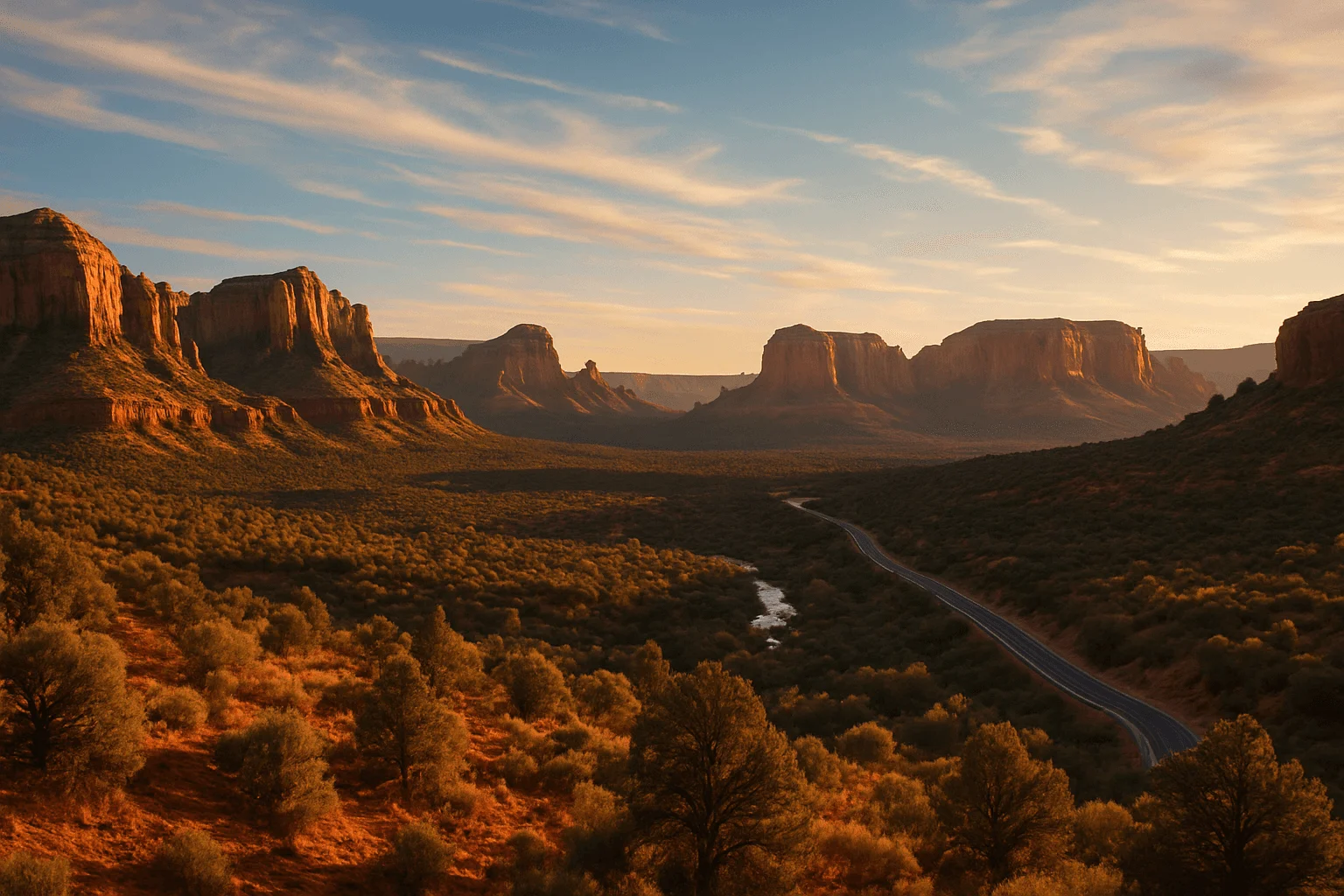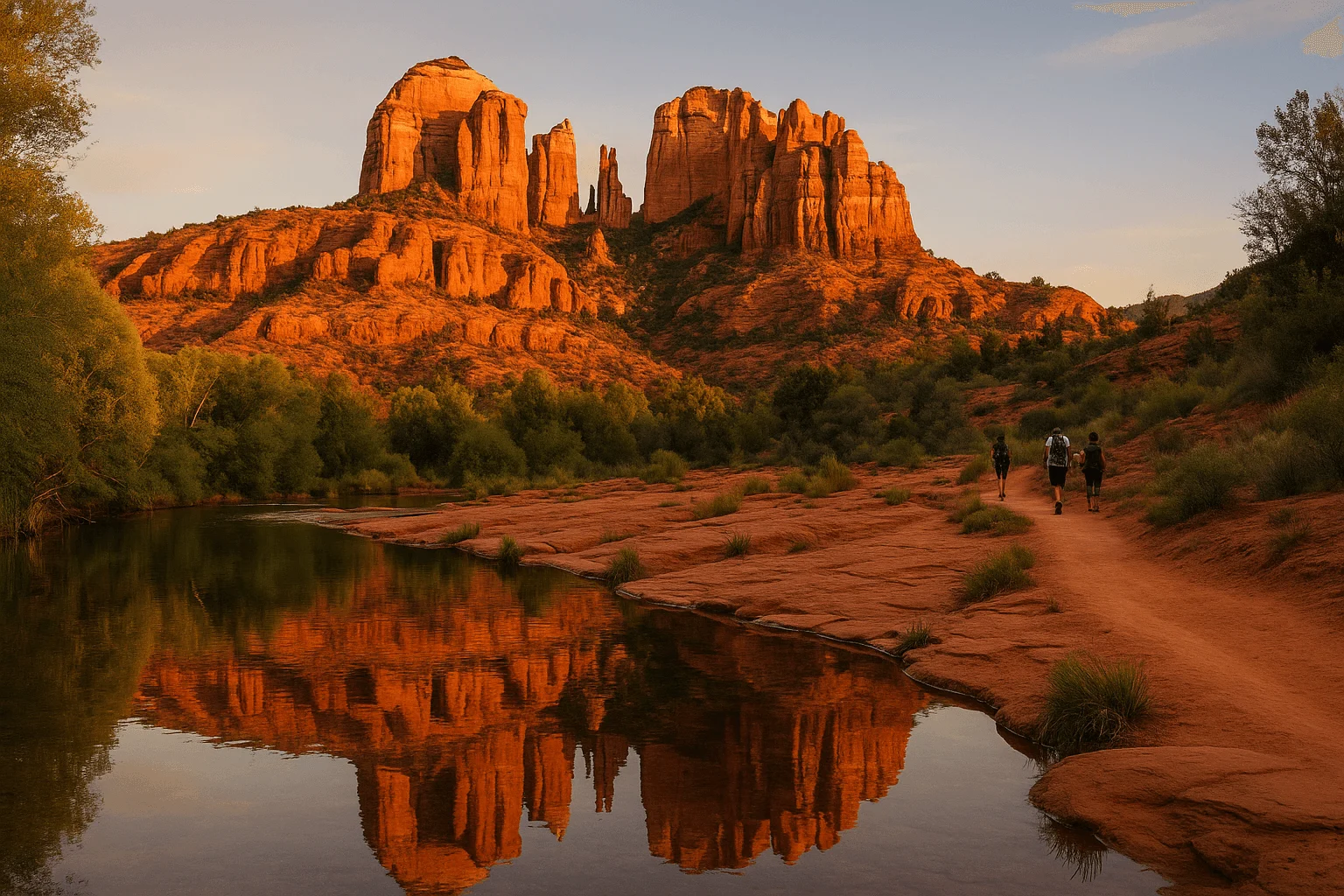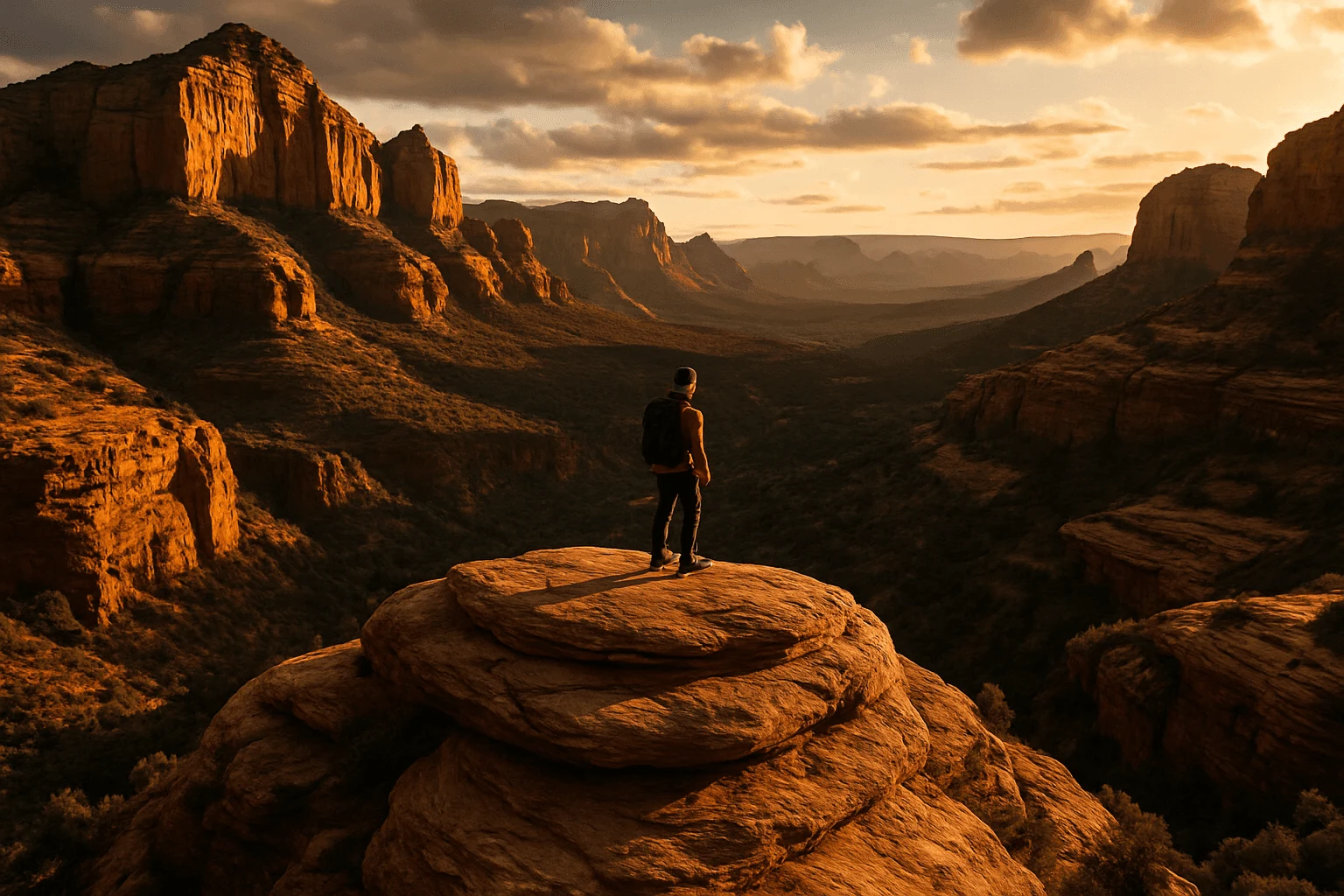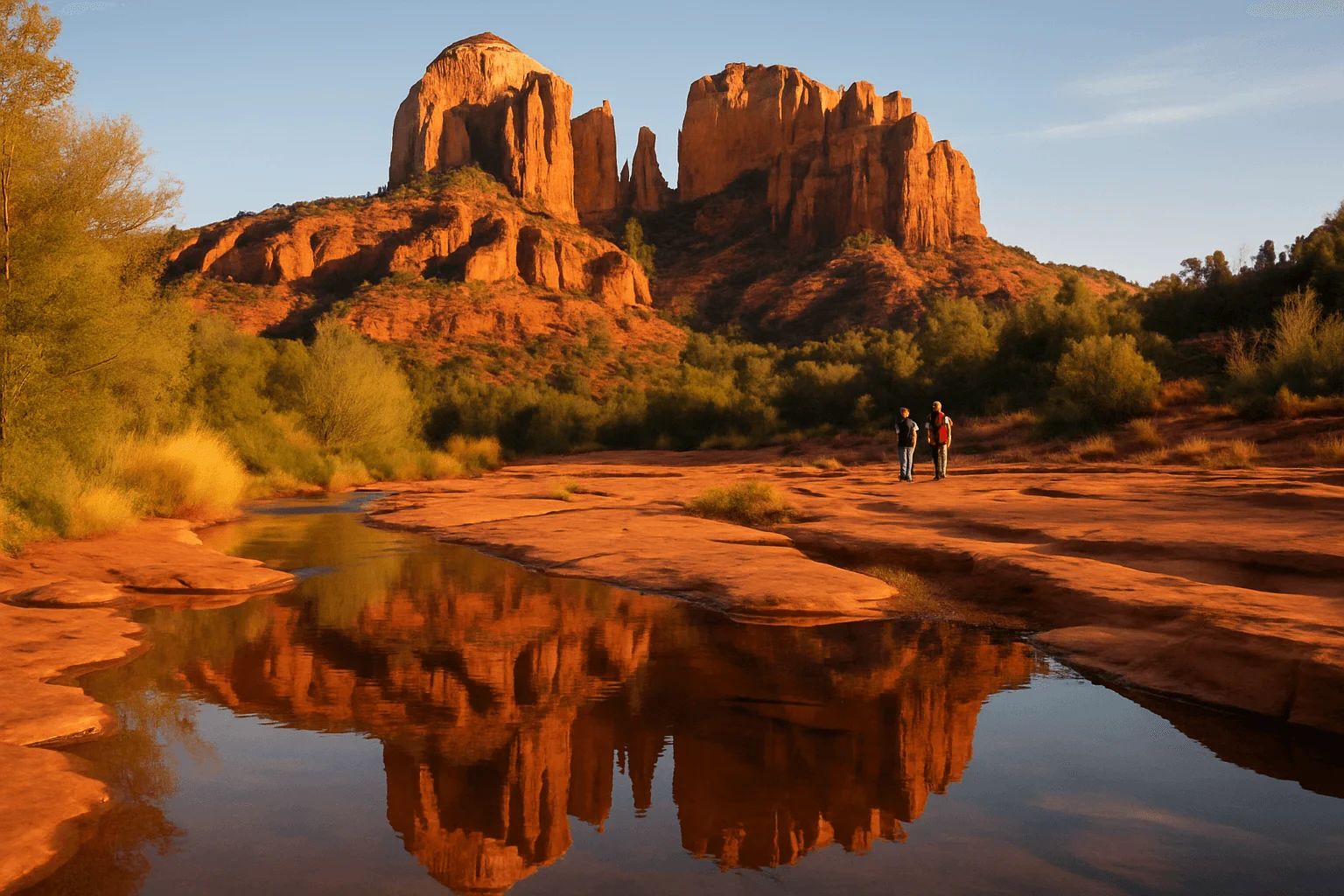
Choose Sedona if the red rocks are the reason you are coming to northern Arizona. Choose Flagstaff if your trip revolves around pine forests, a mountain-town evening, Lowell Observatory or a wider route that includes the Grand Canyon. You can visit both, but where you sleep matters: it determines whether you finish the day watching the rocks change color or looking through a telescope without a canyon drive still ahead of you.
Neither town belongs to only one kind of traveler. Families can have a wonderful Sedona day without scrambling up a rock face; couples can enjoy Flagstaff without skiing or camping. The useful question is what you want to do with your mornings and evenings, then whether the season and your transport make that plan comfortable.
Sedona gives you the red-rock trip; Flagstaff gives you the mountain-town trip
Stay in Sedona when the landscape is the main event
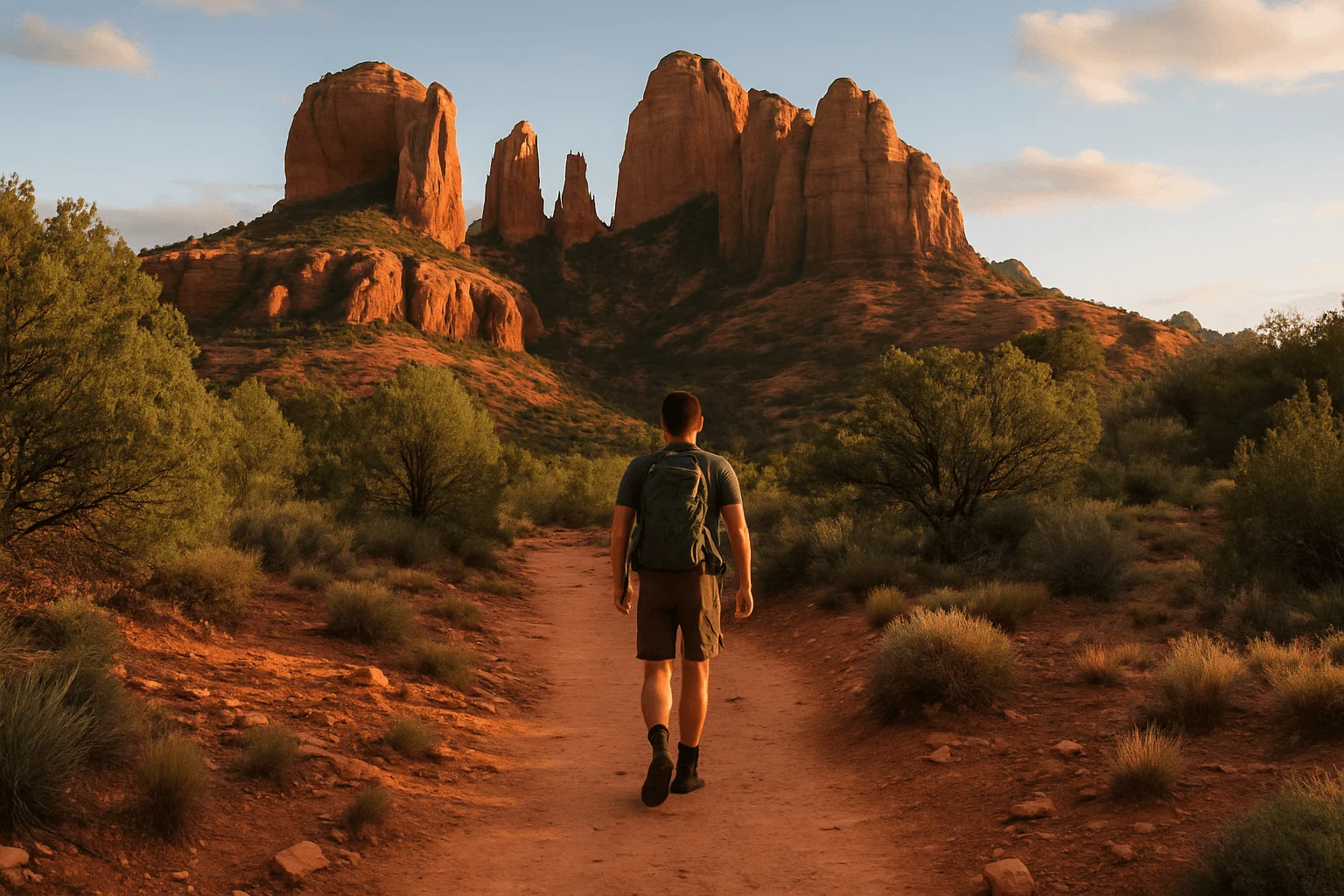
In Sedona, the scenery follows you through the day. Bell Rock rises beside the southern approach on State Route 179, the Chapel of the Holy Cross sits against a rock wall, and Uptown opens onto familiar red-rock silhouettes. You do not have to build an entire visit around a demanding hike to appreciate why people come here.
Sedona works particularly well for a few days of short outings with time between them: a morning trail, lunch, a gallery browse and a slow afternoon back at your hotel. Tlaquepaque adds shady courtyards and art to that rhythm. Nearby on Brewer Road, Mi Amoré Sedona is a thoughtful stop for curated gifts and home-and-garden finds when you want to bring home something beyond another photograph.
The tradeoff is that the name “Sedona” covers several distinct bases. Uptown, West Sedona, the Village of Oak Creek and Boynton Canyon do not share one walkable center. A hotel beside Bell Rock is convenient for the southern red rocks, but it is not an Uptown shopping hotel. Choosing the right area often makes a bigger difference than choosing one more attraction.
Stay in Flagstaff when you want a town as well as the outdoors
Flagstaff has a different texture: ponderosa pines, the San Francisco Peaks, Route 66 and a downtown shaped by a working railway and Northern Arizona University. Start at the Visitor Center in the historic station at 1 East Route 66, then explore the blocks around Heritage Square, Aspen Avenue and San Francisco Street. The appeal is an ordinary town evening mixed into an outdoor trip, rather than a resort stay built around red-rock views.
Lowell Observatory is a strong reason to spend a night here. Walnut Canyon adds a very different landscape and cultural history east of town. Arizona Snowbowl brings skiing in the winter operating season and scenic lift outings when offered. Those attractions are spread out: a walk around downtown does not put you at the observatory entrance, the canyon trail or the mountain lifts.
For a longer northern Arizona road trip, Flagstaff also sits at the junction of Interstate 17 and Interstate 40. That makes it a practical base for several directions of travel. It does not make every regional attraction a quick outing.
Useful orientation: Flagstaff Visitor Center and the official historic downtown walking guide.
The elevation changes the vacation more than the map suggests
Sedona is around 4,500 feet above sea level; Flagstaff is around 7,000 feet. That roughly 2,500-foot difference helps explain why the same trip can include warm red-rock sunshine and a cold evening among the pines. Pack for the places you will actually visit, including higher mountain attractions, rather than using one city's forecast for the whole itinerary.
Spring and fall: choose around the activity, then check conditions
These are appealing seasons for Sedona walking and red-rock outings, but good weather also brings visitors. Reserve important accommodation and timed activities before building a tightly packed weekend. In Flagstaff, cool mornings and evenings call for layers; spring conditions in town do not establish that high mountain trails are snow-free. Fall color is another reason to head toward the peaks, though the timing varies with elevation and the year's weather.
Summer: Flagstaff offers a cooler base, not guaranteed perfect weather
If you want outdoor time without Sedona's hotter afternoons, Flagstaff deserves serious consideration. It still has strong high-elevation sun, and its evening can feel much cooler than the daytime forecast suggests. In Sedona, put exposed walking early in the day and leave the afternoon for a slower indoor or shaded outing.
Summer storms affect both towns. A scenic lift, exposed hike or telescope session depends on actual conditions, not the season's reputation. Give your itinerary a flexible afternoon and consult the National Weather Service's northern Arizona storm forecasts before setting off. A cloudy night at Lowell is not something a longer list of stargazing recommendations can solve.
Winter: Flagstaff for a snow trip; Sedona for a milder base
Choose Flagstaff if snow and skiing are the purpose of the trip, with the mountain's operating calendar and road conditions checked for your dates. For red-rock views and a less wintry town stay, Sedona is usually the more suitable starting point. Sedona can still have freezing temperatures, snow or icy trail sections, so “milder” does not mean every hike stays open and dry.
A winter day trip between the two is a weather-dependent plan. Check AZ511 road conditions before leaving, and follow posted restrictions rather than assuming a rental car is equipped for every mountain condition.
Which town is better for hiking, families and people who do not hike?
Sedona: separate a red-rock walk from a rock scramble
Bell Rock Pathway lets you experience the southern red rocks without committing to a summit climb. It has a wide, hard surface in places, but also hills and rough sections; decide on a short turnaround that matches your group rather than promising everyone an “easy loop.” Cathedral Rock is another proposition. The Forest Service describes a steep, strenuous climb on an exposed route. Its short distance does not make it the default choice for young children, visitors with limited mobility or anyone uncomfortable scrambling.
If the rocks are the draw but hiking is not, combine the Chapel, a scenic drive and town stops. The Chapel's upper approach is uphill, with limited parking and golf-cart assistance; it is not simply a flat roadside viewpoint. Its current visiting hours are 9am–5pm, with last entry at 4:45pm. Our Sedona without hiking guide helps build a day around the amount of walking you want.
A guided ride is another way to spend time in the landscape. Pink Jeep's Red Rock Range tour is a two-hour outing the operator rates 2 out of 5 for adventure, with minimal walking. That is a more appropriate comparison for a gentler sightseeing day than treating every pink Jeep as the same ride. You still need to board the vehicle and tolerate uneven roads; the operator excludes children under two and pregnant guests. Meet at Pink Jeep Plaza, 204 North State Route 89A. The operator requires guests to get in and out of the vehicle themselves and have enough upper-body strength to support themselves during the ride. Choose the actual product for your group, rather than booking by vehicle color alone.
View Pink Jeep Red Rock Range dates on Viator →
Trail and access sources: Bell Rock Pathway, Cathedral Rock Trail and Chapel visiting information.
Flagstaff: choose the specific experience, not a blanket “family-friendly” label
Walnut Canyon is a good example of why the detail matters. The Island Trail is about a mile round trip, descends 185 feet into the canyon and brings you alongside ancestral cliff dwellings. The return climbs back up many stairs at about 7,000 feet. The National Park Service calls it strenuous, and it is not wheelchair accessible. Snow or ice can close it in winter; in summer, a morning visit helps avoid the afternoon storm period.
The Rim Trail is 0.7 miles round trip and keeps you above the canyon. Its first section to the first overlook is paved and accessible; that does not establish that the entire trail suits every mobility need. Ask at the visitor center about the onward surface and current conditions. This makes Walnut Canyon useful for more than one kind of group, provided you pick the right route rather than putting everyone on the Island Trail.
At Snowbowl, distinguish a scenic lift outing from a high mountain hike or ski day. The Arizona Gondola reaches roughly 11,500 feet, far above Flagstaff itself. Operating dates, weather and the opportunity to leave the cabin at the top vary with the product and season; a winter scenic ride does not automatically include the summer summit experience. Check the mountain's current calendar before making it the centerpiece of a day trip.
Plan with the land manager: Walnut Canyon Island Trail, Rim Trail access and Snowbowl operating information.
For stargazing, the evening is a reason to stay in Flagstaff
Lowell offers more than a dark place to look up: there are exhibits, historic telescopes and staff-led learning alongside weather-dependent telescope viewing. That gives an astronomy-minded family or couple a clear reason to choose Flagstaff, especially if you want to have dinner and return for the night sky without another drive afterward.
The consequential scheduling detail is Tuesday. As checked in September 2026, Lowell's public campus is closed on Tuesdays and generally opens noon–10pm on the other days, with holiday exceptions. General admission does not require a reservation; separately booked Premium Access experiences do. Keep the ticket or admission sticker if you want same-day re-entry. Verify the current program and any separately priced shows before paying.
Lowell is at 1400 West Mars Hill Road, on a mesa about a mile west of historic downtown. Its campus is around 7,250 feet, with inclines. Give it its own arrival plan rather than assuming it is a flat extension of your downtown stroll. Bring a warm layer for a telescope queue, and remember that cloud cover can change the viewing even when the campus is open.
Sedona also offers a night-sky setting, but if the goal is observatory exhibits and public telescopes, book the trip around Lowell's calendar. If the goal is a quiet evening at a Sedona resort after a red-rock day, you do not need to move hotels solely because Flagstaff is associated with astronomy.
Current source: Lowell's visit planner, admissions and hours.
How far apart are Sedona and Flagstaff?
For a concrete town-center comparison, Google Maps displayed 29.6 miles and 49 minutes from the Sedona Visitor Center at 331 Forest Road to the Flagstaff Visitor Center at 1 East Route 66, using State Route 89A north through Oak Creek Canyon, when checked September 27, 2026. That is a dated driving estimate between those two addresses, not a guaranteed journey time between every Sedona and Flagstaff hotel.
Allow more time for sightseeing, traffic and changing road conditions. The canyon drive has bends and switchbacks; it is a drive to enjoy attentively, rather than a spare half hour to squeeze between reservations. A viewpoint or creek stop requires a legal parking place and time of its own. Do not count pulling onto a narrow shoulder as an itinerary stop.
If SR89A is restricted, a route using SR179 and Interstate 17 is a longer alternative to check in your navigation app and AZ511. The same Maps observation showed 58.1 miles via I-17 between the two visitor centers. A suggested alternate route is not proof that it is open during a particular storm or incident.
A car makes a combined visit much easier. Sedona's local shuttles serve defined routes or service areas; they are not an intercity Sedona–Flagstaff sightseeing connection. If you are traveling without a car, confirm both your intercity journey and the last-mile arrangements for Lowell, Walnut Canyon or Snowbowl before choosing a base. Staying in either downtown does not solve every attraction transfer.
Check the visitor-center driving route in Google Maps and check current Arizona road conditions.
If the Grand Canyon is part of the trip, Flagstaff is the closer base
The National Park Service places the Grand Canyon's South Entrance about 80 miles north of Flagstaff. Starting in Sedona adds an approach to the northern Arizona road network, so Flagstaff makes more sense when the canyon and other northern stops are the main reason for your journey.
Still, Flagstaff is a regional base, not a town beside the rim. A South Rim day trip has driving at both ends plus possible entrance delays and travel within the park. If sunrise at the rim is the nonnegotiable moment, compare accommodation inside the park or in Tusayan before committing to Flagstaff. Those options serve a different priority from staying somewhere with a wider choice of town evenings.
For a trip centered on Sedona with one canyon outing, staying in Sedona may still be the right choice. Simply give the canyon its own full day and resist adding Lowell or a major hike to the same day. The park's South Entrance directions are the appropriate starting point for the actual approach.
Where to sleep: match the base to the day you want
Do not assume Flagstaff is always cheaper by applying cost-of-living comparisons to a hotel weekend. Compare the same dates, party size and cancellation terms, then include taxes, mandatory fees, parking and the driving your location creates. A lower nightly price is less useful if it puts every planned morning an extra transfer away.
For a Flagstaff stay focused on an evening around downtown, examine the exact hotel's distance to the historic core. A Route 66 address alone is not enough: the road continues well beyond those central blocks. If Lowell is the anchor, confirm its open day first; if skiing is the anchor, compare your mountain approach rather than choosing solely for a downtown dinner.
In Sedona, an Uptown outing pairs with a creekside stay
Amara Resort and Spa, at 100 Amara Lane, is a practical option when Uptown and the creekside resort setting both matter. L'Auberge de Sedona, at 301 L'Auberge Lane, also brings the Oak Creek setting into an Uptown-area stay. Both sit below the main shopping road: “near Uptown” should not be read as a promise of a level walk from every room. Choose the property and room setting you actually want, then confirm the route if walking access is essential.
View Amara rooms on Expedia →
View L'Auberge rooms on Expedia →
For West Sedona, start with the outings west of the center
The Wilde Resort and Spa, at 2250 West State Route 89A, puts you in West Sedona. It suits a plan that uses this side of town and returns to a resort afterward; Uptown and Tlaquepaque remain separate outings. This is a location choice, rather than a substitute for checking transport if you want to leave the car parked all weekend.
View The Wilde rooms on Expedia →
For a retreat, Boynton Canyon is its own destination
Enchantment Resort, at 525 Boynton Canyon Road, is worth considering when the canyon setting and time on the property are central to the vacation. It is a different style of Sedona base from an Uptown-area hotel. Make room in the itinerary to enjoy it, rather than choosing it for a trip that has you driving away for every meal and activity.
View Enchantment rooms on Expedia →
For Bell Rock, look to the Village of Oak Creek
Hilton Sedona Resort at Bell Rock, at 90 Ridge Trail Drive, is in the Village of Oak Creek, with the southern red-rock landmarks nearby. It suits a Bell Rock and SR179-focused trip. It is not in Uptown, and a Flagstaff outing still means driving north through or around Sedona. That distinction matters more to this comparison than another list of pool or room amenities.
View Hilton Sedona rooms on Expedia →
A sensible day in each town
One Sedona day: leave room to enjoy the rocks
Start with a short Bell Rock Pathway outing if the weather and your group suit it, or begin with the Chapel if hiking is not the plan. Choose one main outdoor experience, then have lunch and slow down around Tlaquepaque. You do not need to add Cathedral Rock, a long canyon stop and a Jeep departure simply because they all appear on a “best of” list.
If you enjoy finding a small shop with a sense of place, visit Mi Amoré Sedona in the historic Hart Store at 100 Brewer Road. It is near the Tlaquepaque/Brewer Road part of the day, not on Uptown's Main Street. The shop opens daily, 10am–4:30pm, so make it an afternoon stop rather than something to save until after dinner. Continue to Uptown if you want another browse, or keep the late day free for your hotel and a relaxed meal.
One Flagstaff day: choose the canyon or the mountain before the evening
For a history-and-astronomy day, visit Walnut Canyon in the morning, choosing the Island or Rim Trail according to your group. Spend the afternoon around downtown, then visit Lowell on an open day. General admission's same-day re-entry makes an afternoon visit followed by dinner and a return for telescope viewing possible, subject to the actual program and weather.
If the mountain is the priority, replace Walnut Canyon with Snowbowl rather than stacking both into the same morning. Skiing, a scenic ride and a mountain hike are different commitments. Keep downtown dinner as a welcome end to the day, and add Lowell only if the timing and your energy make it enjoyable.
Should you visit both, or choose one?
With one day, choose the place that contains the experience you most want. Red-rock scenery points to Sedona; an observatory evening or winter mountain outing points to Flagstaff. You can drive through both, but a drive-through is not the same as having time to settle into either.
With two nights and a primarily Sedona trip, staying in one Sedona base usually keeps the visit simpler. Add Flagstaff as a deliberate full-day outing if it offers something you care about, accounting for the late return if Lowell is included. If your trip is mostly Flagstaff and the Grand Canyon, reverse that arrangement and give Sedona a focused day.
With three or four nights, a split stay can make sense: spend the Sedona portion on red-rock mornings and unhurried town stops, then move north for a Flagstaff evening and the next leg of the road trip. Change hotels because it removes an inconvenient return journey or brings you closer to the next destination, rather than because the two towns must receive equal time.
The best choice is the one that lets your favorite part of the trip happen at the right hour. Sedona rewards time with the red rocks. Flagstaff rewards time with the forests, the town and the night sky. Plan around that, and the comparison becomes much easier.
GOOD TO KNOW