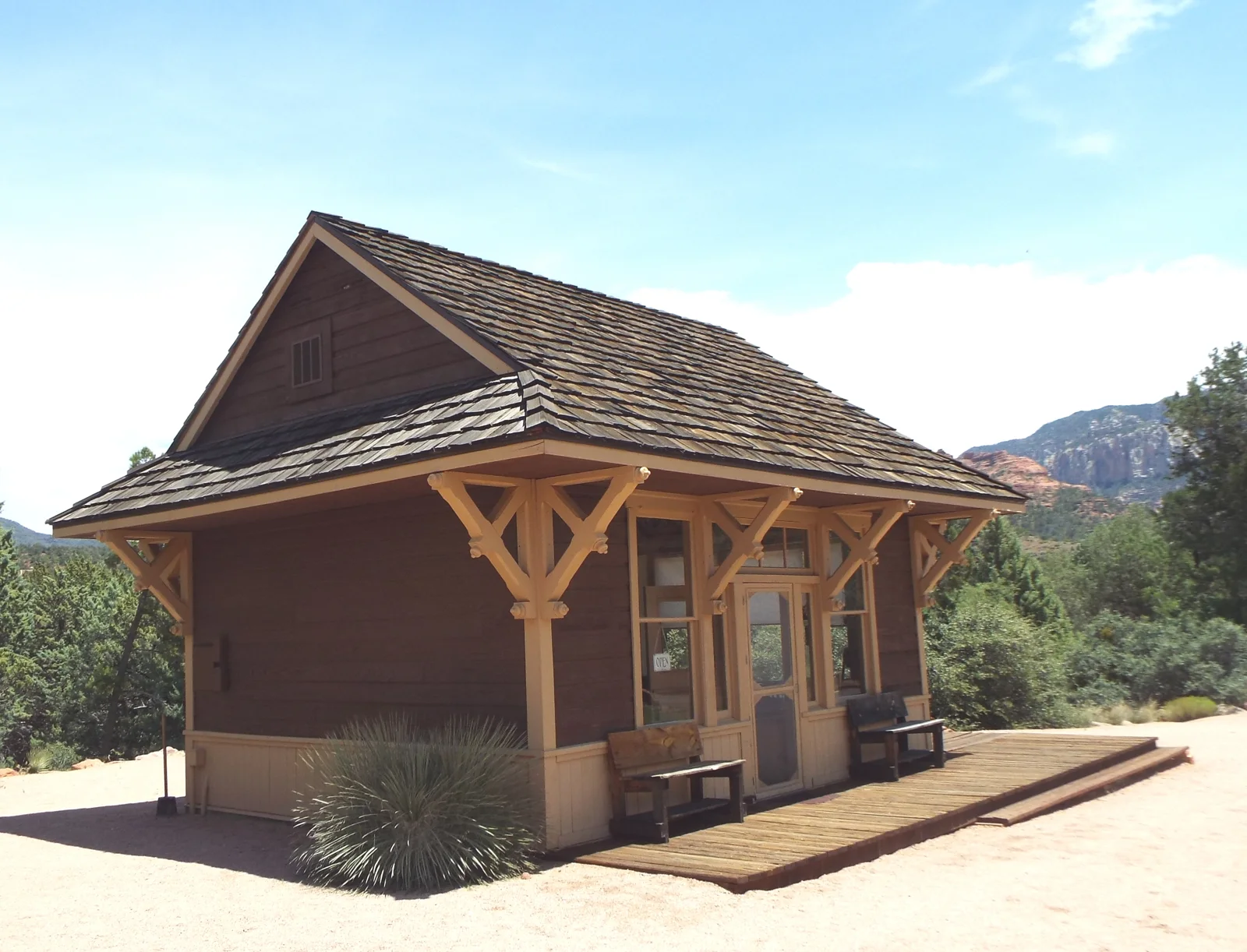
Sedona has a movie souvenir you can actually visit: a little wooden building that played a telegraph office in a John Wayne Western. It now stands at the Sedona Heritage Museum, far from its original life as a railroad depot in Winona. That journey—from working building to movie prop to museum exhibit—is a good introduction to the town’s other career.
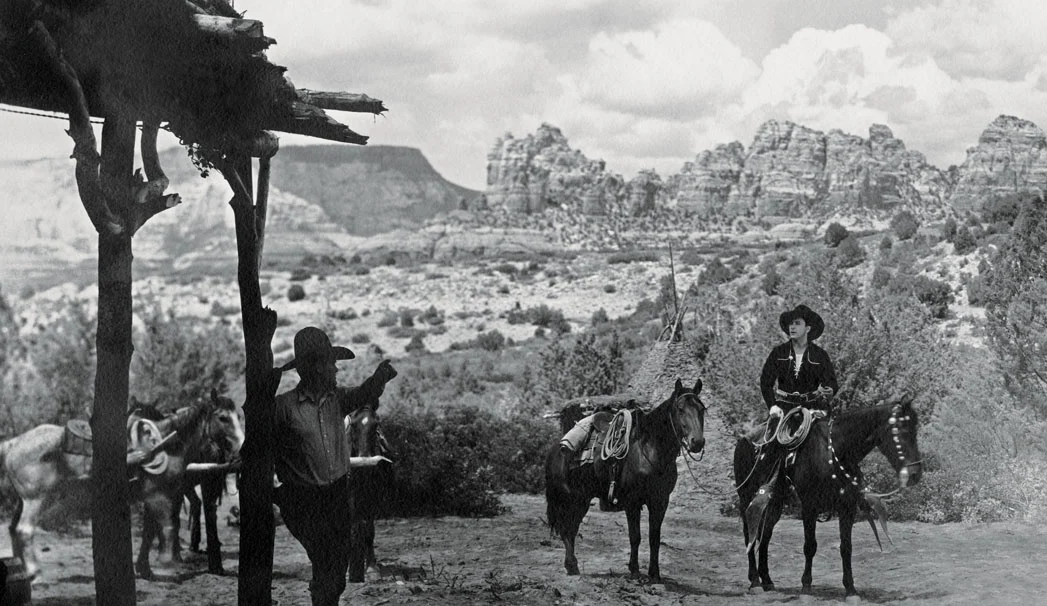
Long before a phone camera became essential luggage, filmmakers were putting Sedona on screen. Five especially rewarding starting points are Angel and the Badman, Blood on the Moon, Broken Arrow, Johnny Guitar, and the original 3:10 to Yuma. They offer romance, uneasy loyalties, spectacular scenery, and a reminder that a film’s setting and its shooting location can be very different places.
Choose one before your trip, then give the museum a place in your Sedona plans. You do not need to recognize every rock or spend a day hunting down camera positions to enjoy the connection.
Why Sedona became part of Hollywood’s West
The official Sedona visitor guide traces local moviemaking to the 1923 silent film The Call of the Canyon. The five films below came later, during the decades when Westerns brought major studios and familiar stars to Red Rock Country.
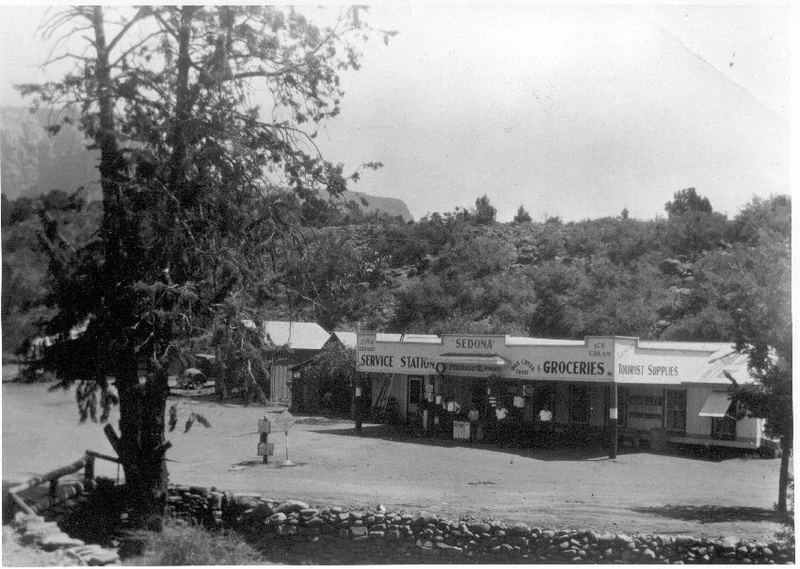
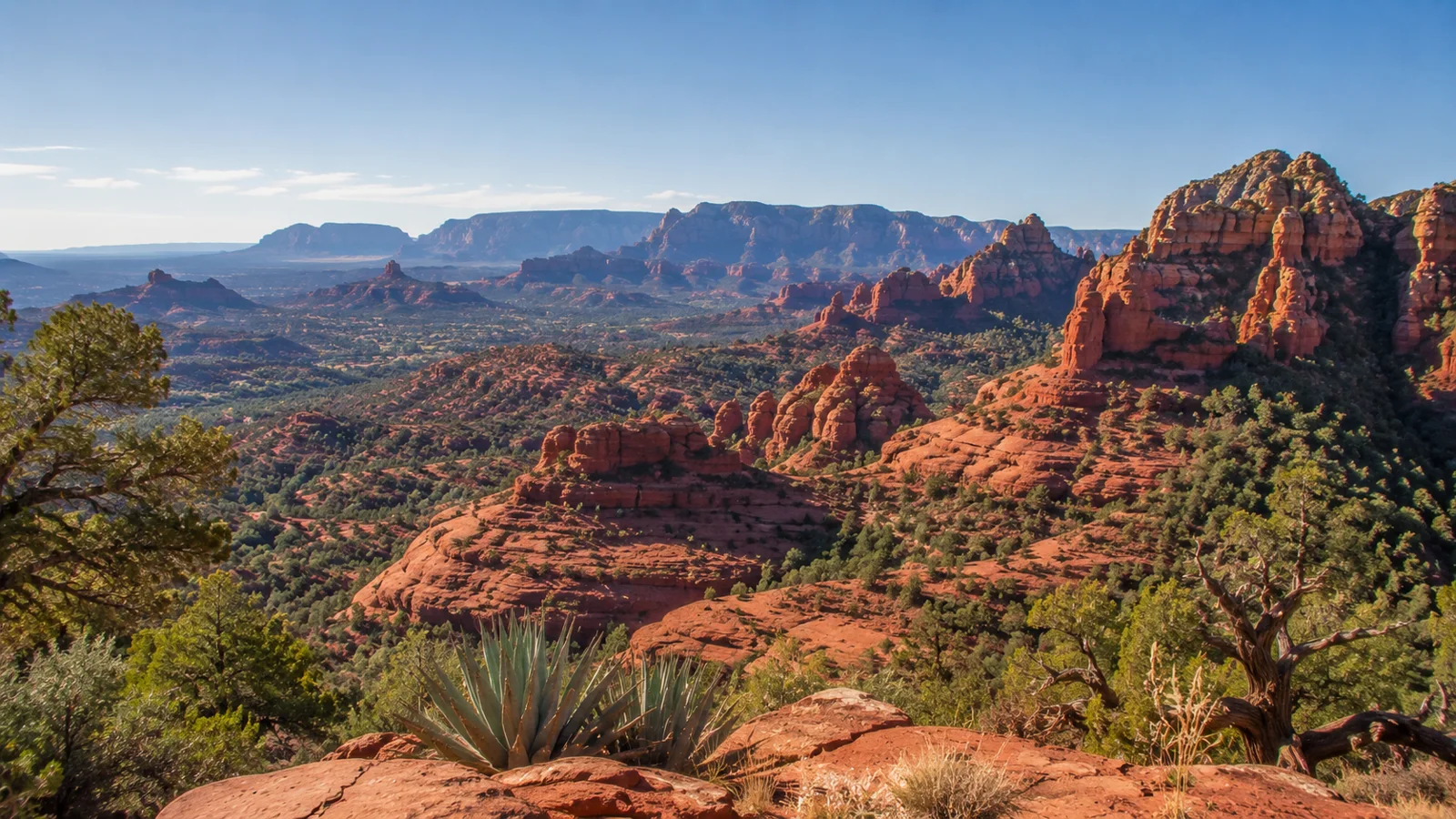
The landscape gave filmmakers variety: creekside vegetation, open country, and dramatic rock formations could serve different stories. The work reached beyond the actors. In Arizona Highways’ account of Sedona filmmaking, photographer and film worker Bob Bradshaw recalled supplying locations, horses, and equipment. The Sedona Historical Society’s archive describes an industry that brought income as the town’s agricultural economy changed.
Keep two histories in mind as you watch. One is the production history: who worked here and what the camera recorded. The other is the story on screen, which may compress events, invent relationships, or turn Arizona scenery into somewhere else. Our broader history of Sedona places the film years within the much longer story of the place and its people.
1. Angel and the Badman: John Wayne and the building that survived
Start here if you want the clearest connection between a movie night and a museum visit. Released in 1947, Angel and the Badman stars John Wayne as wounded gunman Quirt Evans and Gail Russell as Penny Worth, whose Quaker family takes him in. Their beliefs make his accustomed response to danger—violence—harder to accept.
The American Film Institute’s record identifies James Edward Grant as writer and director and documents location work in Sedona as well as other places. It also marks the film as the first production of Wayne’s Patnel company. You are watching an early step in his work behind the camera, alongside his much more recognizable presence in front of it.
For a first viewing, pay attention to how the domestic scenes change the stakes. The question is not simply whether Quirt can defeat someone. It is whether he can imagine a different life. That gives the story an approachable emotional thread even for a traveling companion who would not normally choose a Western.
The museum’s exhibit description connects the surviving depot building specifically to this production. It had been moved from Winona to Sedona’s Western town set, where it became a telegraph office. Seeing it afterward gives you a tangible piece of the production to remember, rather than another unverified “filmed somewhere near here” claim.
2. Blood on the Moon: a darker side of Red Rock Country
Choose this one for suspicion and shifting loyalties. Robert Mitchum leads the 1948 film as Jim Garry, a drifter drawn into a cattle dispute through an old acquaintance. Robert Preston plays that acquaintance, Tate Riling, and Barbara Bel Geddes is part of the cast. Robert Wise directs.
The black-and-white film belongs to the conversation about noir Westerns: stories in which uncertainty about people can matter as much as a threat on the horizon. The AFI synopsis and production record lay out a scheme in which the explanation Garry initially accepts does not tell him what he really needs to know.
Its Sedona connection is more than a modern location-list entry. A 2010 Sedona Monthly feature includes a photograph identifying Mitchum at Red Rock Crossing during filming, and a later Red Rock News interview with the museum’s director discusses a scene made there. Those records provide a firmer connection than trying to match every distant ridge yourself.
Watch this alongside Angel and the Badman if you want two different moods from roughly the same period. One useful question for the pair is how trust is earned: through care and patience in one story, through disentangling a deceptive proposition in the other. A recognizable landscape need not produce the same kind of film.
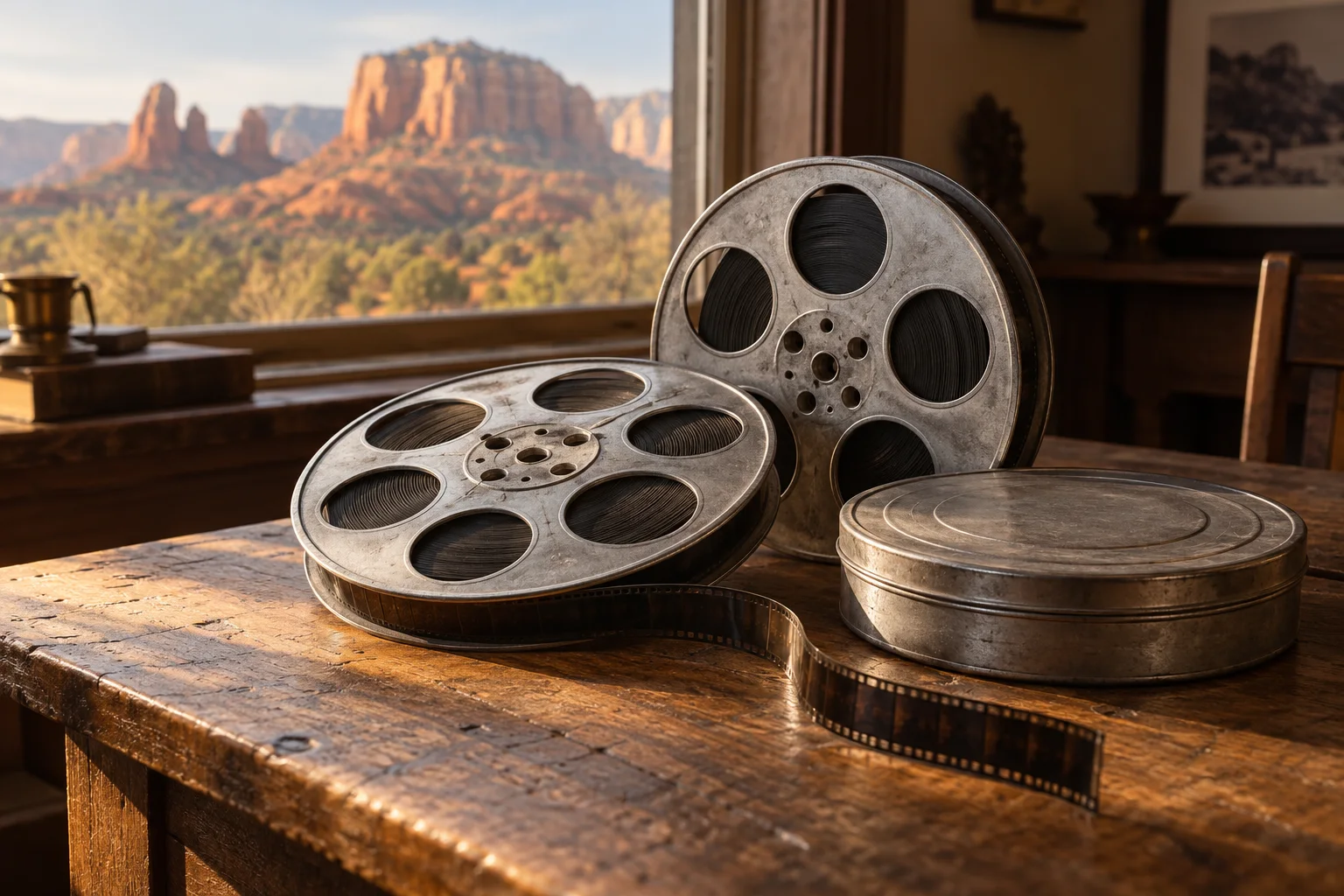
3. Broken Arrow: beautiful country, complicated history
Pick the 1950 film for a story that rewards a second conversation afterward. James Stewart plays Tom Jeffords, with Jeff Chandler as Cochise and Debra Paget as Sonseeahray. Directed by Delmer Daves, it builds its drama around attempts at understanding and peace between people in conflict.
Arizona Highways documents the film’s Sedona connection, alongside work in other Arizona locations. But the red rocks should not be read as proof that the historical events happened where the camera stood. The AFI production history for Broken Arrow explains that the real 1872 meeting involving Jeffords, General Oliver Otis Howard, and Cochise took place in the Dragoon Mountains in southeastern Arizona.
There is another significant distinction: AFI records that the source novelist acknowledged the Jeffords–Sonseeahray romance as fictional. The film can therefore introduce questions about history without settling them. Its landscape, central relationship, and casting are choices made by a Hollywood production, not an unmediated account of Apache life.
For a visitor, that distinction makes the viewing more interesting. Ask which parts of the story the location makes persuasive, then separate that visual impression from the historical record. Enjoy the scenery while leaving room to learn from sources beyond the film. It is a more rewarding approach than treating a Western as either a documentary or merely a sequence of pretty backgrounds.
4. Johnny Guitar: Joan Crawford takes the lead
This is the choice for a Western with a very different center of gravity. In Nicholas Ray’s 1954 film, Joan Crawford plays saloon owner Vienna, Sterling Hayden is Johnny, and Mercedes McCambridge plays Emma, Vienna’s fierce opponent. AFI’s production notes confirm that portions were filmed around Sedona.
The title gives you a man’s name, but the conflict between the two women is central to the film’s appeal. In his essay hosted by the Library of Congress, film distributor Michael Schlesinger emphasizes that unusual balance and the picture’s forceful color design. It makes a lively contrast with the black-and-white world of Blood on the Moon.
There is a recent local reason to revisit it. Red Rock News reported on October 9, 2026, that Sedona’s Historic Preservation Commission had designated the Johnny Guitar House a historic landmark at its August 17 meeting. The reporting describes photographic evidence connecting the building to Johnny Guitar, correcting an earlier association with the 1944 film Tall in the Saddle.
The practical point is simple: the house is private property, not an advertised visitor attraction. Historic designation does not create permission to enter or a public tour. Its story is worth knowing; the museum is the place to build into your itinerary. The reporting also leaves parts of the building’s movement history uncertain, so a confident-sounding address-to-scene route would promise more than the evidence supports.
5. 3:10 to Yuma: a famous title with a short Sedona shoot
Choose the 1957 original for a concentrated contest of nerve. Glenn Ford plays outlaw Ben Wade and Van Heflin plays rancher Dan Evans in Delmer Daves’ black-and-white film. A drought-stricken rancher’s decision to help deliver an outlaw to a train becomes a test of what he is willing to risk and what might change his mind.
The AFI catalog lists a 92-minute running time and location work near both Tucson and Sedona. The Sedona Historical Society’s archive entry adds a revealing detail: the cast and crew spent only two days in Sedona, working mostly at the Western town set.
That is a useful correction to the impression a familiar title can create. Sedona contributed to the film; it did not provide every location. The archive also describes housing development making Western filming increasingly difficult. What had worked as an open-looking screen landscape was becoming a town with more visible signs of everyday life.
Check the year when choosing a copy: this is the 1957 production. The same title has been used again, and a search result alone does not establish which version you have found. If you enjoy the ethical conflict more than identifying scenery, this is a particularly useful entry point into the list.
Turn the watchlist into a Sedona museum visit
The Sedona Heritage Museum is at 735 Jordan Road in Uptown. Its current visitor information lists daily opening hours of 11 a.m.–3 p.m., with closures on major holidays. Admission is $10 for adults; children under 13 are free. These details were checked October 15, 2026; confirm the current schedule before making a special trip.
Plan the museum before a long lunch or an afternoon of browsing, because its closing time comes early. The telegraph office reached the museum property in 2014. You are visiting a preserved building in a museum setting, not walking through an intact Hollywood backlot.
Bring one film title and one question. You might want to know more about the telegraph scene, the people who worked on the productions, or how a set related to the surrounding town. Ask what material is currently on display rather than expecting a particular poster or prop from every film on this list.
For more viewing before or after your trip, browse the Historical Society’s Arizona’s Little Hollywood digital collection. Its photographs and descriptions reveal the working side of filmmaking. Read each caption carefully: an image of a familiar landscape, a publicity photograph, and a production still tell different kinds of stories.
Leave room for Sedona’s life beyond the set
You can make this a town-focused day without filling it with movie-location stops. Begin with the museum, leave time for a meal, and choose the next stop according to what interests your group. Our Sedona walking-afternoon guide explains the different areas and the extra distance involved in adding the museum.
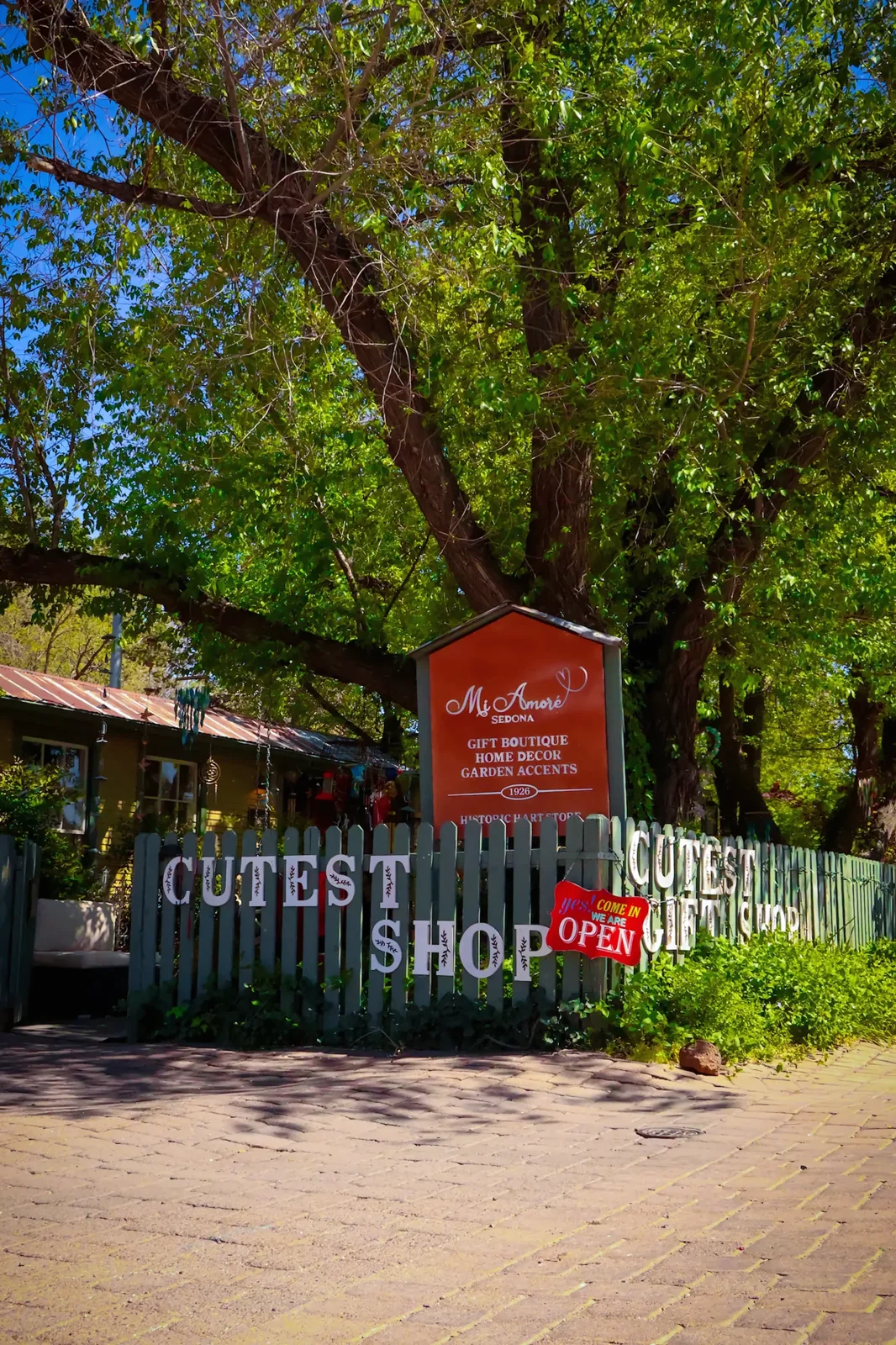
For a separate stop in a historic building still in everyday use, visit Mi Amoré Sedona in the Hart Store at 100 Brewer Road. Our shop offers curated gifts and pieces for the home and garden, with daily hours of 10 a.m.–4:30 p.m. It is a place to browse and bring home a memory of this trip; it is not presented here as a filming location.
If you would like to finish with a film, check the Sedona International Film Festival’s current program. Its listings include screenings at the Mary D. Fisher and Alice Gill-Sheldon theatres beyond the annual festival. Select the actual date, venue, and ticket for your visit; none of the five classics above is promised to be showing.
Watching one old film, seeing one surviving set building, and enjoying a current screening can give the movie connection a satisfying shape. Leave the private houses to their residents and the uncertain camera positions to further research. There is plenty to discover in the documented stories.
Cover photograph: the museum’s telegraph office, photographed in 2019 by Marine 69-71 via Wikimedia Commons. Resized, converted to WebP, and cropped for display; this photograph and its adaptations are licensed under CC BY-SA 4.0.